
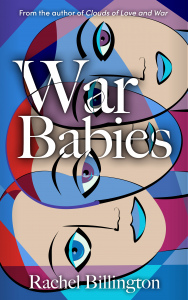
War Babies
Published by Universe at Unicorn, May 2022.
This is the story of three sisters, Millie, Di and Cleo. They are the war babies. Growing up in a world hungover from war, the sisters struggle to leave their mother behind and build their own lives. Millie turns to marriage, motherhood and God. Di becomes a foreign correspondent, finding a role in war-time Vietnam. Cleo chooses words as a defence against the world. A successful novelist, for a time she is content to be a sardonic voyeur.
Each sister is lost in her own world where extreme need leads to extreme behaviour. Then Cleo, the youngest and wildest, becomes the catalyst to smash the pattern. Who will adapt and survive? Who will find peace?
From the 50s to the present day, and with elements of a psychological thriller, I tried to show how three women navigate a future where men are not the only answer. The focus shifts from one sister to the next, putting human nature, its flaws and its virtues, under the spotlight. Yet there is hope at the heart of this story which leaves the reader wondering long after the final twist is revealed.
Other Writing
- How Emma persuaded me to write ‘Perfect Happiness’
- Impossible to believe that Miss Emma Woodhouse could change anyone’s mood for the better. Conceited, narrow-minded, snobbish, insensitive are just... Read more
- Covid 19 – Buster’s Story
- It all started well. Jim was suddenly at home more. Actually, all day. The morning walk was a little longer... Read more
- Politics
- ‘Oh politics!’ exclaimed Dan as if that was the end of the matter. ‘But I was stopped in the street.... Read more
- The Wild Cherry Tree (Prunus avium)
- The Wild Cherry Tree is a hermaphrodite, both male and female, and more than a little poisonous. But this didn’t... Read more
Thoughts
-
My Stories
 Writing a memoir goes against the grain of a novelist. The thrill of putting pen to paper (metaphorically speaking) is the creating of something entirely new, introducing into the world people who didn’t exist until you gave them life. By comparison, rehashing old memories is a dull activity – except perhaps for the very self-centred. The only way to make it bearable, I decided, was to turn the memories into stories, if possible catching hold of enough facts to haul them back before they float off into fiction. But even then, I became bored. In the middle of describing my time in 1970s’ Hollywood, I find a character emerging from the palm trees who is not Kevin (my husband / director), nor Stirling Silliphant (producer), nor Anthony Quinn (potential actor), but an unknown male, thrusting his way onto the stage, commanded there by my unruly imagination. London and New York a few years earlier, are also peopled by interlopers, drunk associates, small millionaires who drive Rolls Royce and invite me to their water-beds. Seeing the way things are going, I have evolved a coping strategy: I am putting down the true facts of my life (more or less) interspersed with true fiction from my imagination. At the moment it seems to sort the problem. We will see.
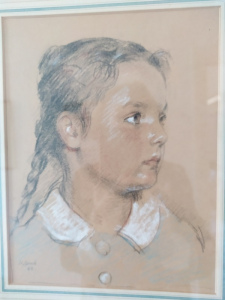
The serious little girl (pictured), is me in 1958, drawn by Bloomsbury artist Henry Lamb. He married my aunt Pansy, and drew all eight of us children when we were five or six years old. I can remember feeling personally responsible for the outcome, and annoyed he had made my plait so skimpy.